Field Atlas № 01— Of fluxes, fires & the cooled glass —Vol. I / 2026
The Chemistry of Ceramic Glaze
A fired glaze is a thin sheet of glass that the kiln re-builds, atom by atom, from
a powder of ground rocks. To make sense of it — to bend a colour, to chase a
crystal, to stop a craze — you have to learn the language of oxides.
This is a tour through that language, beginning at the three pillars and
ending at the kiln door.
Form
Field Atlas
Subject
Glaze Chemistry
Plates
76
Sources
9 cited
Glass-former SiO₂
Stabilizer Al₂O₃
Fluxes R₂O · RO
Colour Cu · Co · Fe
Atmosphere O₂ ⇌ CO
Surface Matte · Bright
I
Prelude — what a glaze actually is
A definition, a useful inversion, and the only mental shift that matters before reading further.
Powdered rocks dispersed in water — that is what a glaze is in the bucket. A thin glass skin fused onto fired clay — that is what a glaze becomes after the kiln. Between those two states lies the whole subject.
Most studio thinking begins and ends at the level of the recipe: 40 parts feldspar, 30 silica, 20 whiting, 10 kaolin. That is useful for measuring out a batch — and useless for understanding why one batch gives celadon and another gives matte mud. Inside the kiln the recipe disappears. Whiting (CaCO₃) breaks open at red heat, releases a puff of carbon dioxide, and surrenders its CaO. Feldspar fractures into K₂O, Al₂O₃ and silica. Kaolin loses its water and gives up the same alumina and silica from a different shape of molecule. By the time the glaze has melted, the kiln no longer cares which sack the materials came from. It only cares about the oxides in the melt.
That is the inversion this whole atlas runs on. Stop seeing a glaze as a list of ingredients; start seeing it as a budget of oxides. Each oxide carries documented contributions — to melting temperature, to thermal expansion, to surface, to colour, to durability. You can predict and adjust those contributions long before you mix a test tile. This is the gift Hermann Seger gave the craft in the 1880s and that Tony Hansen, Ian Currie, Linda Bloomfield and Glazy.org carry forward today.
The materials list still matters — it determines particle size, suspension, application, and any oxides that survive incompletely melted. But the cooled glass is an oxide architecture, and the rest of this atlas is a tour through its members and their habits.
II
The Three Pillars of every glaze
Glass-former, stabiliser, flux. Every studio glaze on every continent — Tang celadons, Oaxacan green, Bristol white, your own next test tile — is a balance of these three.
Pillar I · Bones
Glass-former
SiO₂ · (B₂O₃, P₂O₅)
Silica is the backbone of all ceramic glazes — the molecule that cools into clear glass. Pure silica melts only above 1700 °C / 3100 °F, far hotter than any pottery kiln, so we do not melt it on its own. We dissolve it into a flux instead. More silica = harder, more durable, lower-expansion glaze. Boron and phosphorus also build glass network and modify it.
SourcesQuartz · Feldspar · Clay · Wollastonite
Pillar II · Flesh
Stabiliser
Al₂O₃
Alumina raises the viscosity of the melt — it stops the glaze running off the pot, makes the surface more durable, and beyond a certain ratio it breaks the glass into a matte. Technically it is an intermediate: it can sit either side of the glass network. Most recipes carry alumina hidden inside their kaolin, ball clay, and feldspar.
SourcesKaolin · Ball Clay · Feldspar
Pillar III · Blood
Fluxes
Na₂O · K₂O · Li₂O · CaO · MgO · BaO · SrO · ZnO
Fluxes lower silica's melting point so a glaze can melt at studio temperatures (cone 06 — cone 10). Each flux pulls the melt in a different direction — gloss, matte, low expansion, high expansion, crystal growth, colour shift. Choosing the flux mix is the most decisive act in glaze design.
Boron occupies a peculiar middle ground. Chemically it is a network former like silica, but in studio practice it behaves like a flux — it sharply lowers the temperature at which a glaze melts and broadens the firing range. Almost every commercial low-fire and mid-fire glaze leans on boron, usually delivered through a frit. Phosphorus, supplied by bone ash or wood ash, is also a network former, and even small amounts seed crystal growth and shift colour into pastels and opalescents.
III
The Seger Formula & Unity
A standardised way to compare two glazes, devised in 1880s Berlin, still the lingua franca of glaze chemistry today.
The chemist Hermann Seger arranged glaze oxides into three columns that map onto the three pillars: RO · R₂O₃ · RO₂ — where R stands for any element combining with oxygen. The left column holds the bases (the fluxes); the right holds the acids (the glass-formers); the middle holds the amphoteric intermediates (alumina). The ratio of oxygen rises from left to right, like the three movements of a chord.
To compare two glazes meaningfully, the formula is normalised so the flux column adds up to one. This is called unifying on the fluxes — or flux unity — and is what every modern glaze calculator (Glazy, Insight-Live, Matrix, GlazeMaster) outputs by default. With the fluxes pinned at 1.0, the alumina and silica numbers become directly comparable across recipes, kilns, and centuries. A typical cone 6 stoneware glaze sits near Al₂O₃ ≈ 0.3 · SiO₂ ≈ 3.0; a cone 10 reduction glaze pushes silica to 4.0+.
Three other notations live alongside Seger. Mole percent drops the columns and just gives the proportion of each oxide molecule by number — it captures interplay better at low fire, where some "fluxes" are actually refractory. Percentage analysis is by weight rather than count, which is what manufacturers print on raw-material data sheets. Loss on ignition (LOI) is the weight a raw material gives up to the kiln as gas — water from clay, carbon dioxide from carbonates. The fired glaze itself has zero LOI; only raw materials carry one.
Worked example — a Seger formula, raw vs unity
Oxide
Group
Raw
÷ flux total 2.2
Unity
K₂O
RO (flux)
0.6
0.6 / 2.2
0.27
CaO
RO (flux)
1.3
1.3 / 2.2
0.59
MgO
RO (flux)
0.2
0.2 / 2.2
0.09
ZnO
RO (flux)
0.1
0.1 / 2.2
0.05
Σ flux
2.2
1.00
Al₂O₃
R₂O₃
0.9
0.9 / 2.2
0.41
SiO₂
RO₂
9.0
9.0 / 2.2
4.09
IV
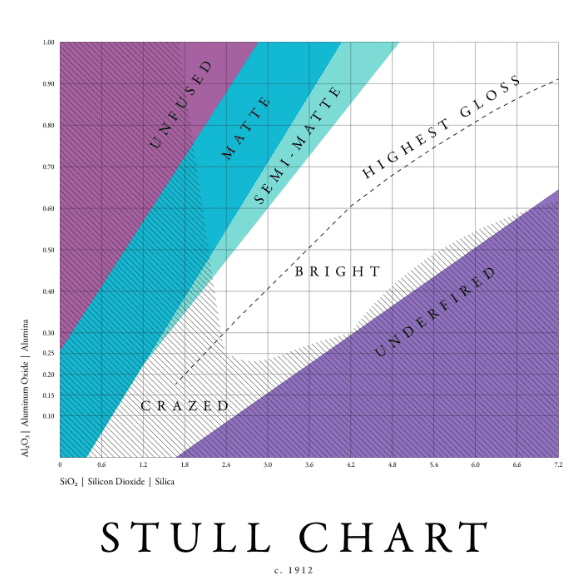
The Stull Chart
In 1912 R. T. Stull fired hundreds of cone-11 test tiles, each varying only in silica and alumina, and produced what is still the single most useful map in studio glaze work.
Hold the fluxes constant. Move silica left → right. Move alumina bottom → top. Fire to cone 11. The fired tiles fall into bands. Bright (glossy) glazes cluster where there is enough silica to glass over and not so much alumina that the melt stiffens. Drop the silica or pile on alumina and the surface roughens into matte. Overshoot silica without proportional alumina and the unfused glass crazes from thermal-expansion mismatch. Below a minimum total, the powder never melts at all. Above a maximum, it devitrifies into a crystalline mat. The boundary between matte and semi-matte sits near a silica:alumina ratio of 4 : 1; the boundary between semi-matte and bright near 5 : 1.
Stull-style silica/alumina map, after R. T. Stull (1912), as redrawn and annotated by Ceramic Materials Workshop. Horizontal axis is silica (SiO₂) molecules; vertical axis is alumina (Al₂O₃). The coloured zones map fired surface character — underfired, matte, satin, glossy, crazed — onto the molar Si:Al landscape.
How to read it. Hold the fluxes constant, vary only silica (left → right) and alumina (bottom → top), and fire at one temperature. The fired tiles fall into bands. The boundary between matte and semi-matte sits near a silica:alumina ratio of 4 : 1; the boundary between semi-matte and bright glossy near 5 : 1. Underfired glazes cluster in the lower-left where there is too little silica + alumina to form a melt; crazed glazes cluster top-right where the glass is too alkaline-rich to resist tensile stress as it cools.
Unfused
Too little silica + alumina to form a melt. Powdery, immature surface — the bottom-left corner of the chart.
Matte
Si:Al below ~4:1. Surface roughened by sub-microscopic crystals or unmelted alumina. Calcium & magnesium mattes live in this band.
Semi-matte / satin
Between 4:1 and 5:1. The sweet zone for soft-handed functional glazes — enough silica to mature the melt, enough alumina to keep it from going glossy.
Bright (glossy)
Si:Al above ~5:1. Most clear glazes live here. Hardness, durability, and shine are all maximised.
Underfired
The melt has not reached maturity at the firing temperature — usually a problem of insufficient flux, too much alumina, or undershot heatwork.
Crazed
Glass too thin to resist tensile stress as it cools. Solution is more silica, more alumina, or lower-expansion fluxes (swap K₂O/Na₂O for Li₂O or MgO).
Devitrified
Excess silica with low flux re-crystallises as it cools — a milky, crusty, undermelted surface in the upper-right.
Treat the chart as a metaphor, not a law. Other oxides — boron, lithium, cooling rate, the clay body underneath — all bend the boundaries. But the broad geography (matte ↘, bright ↗, craze top-right, unfused bottom-left) is reliable across most studio temperatures.
V
Atlas of Fluxes
Eleven oxides do almost all the melting work. They split into three temperaments — alkali, alkaline-earth, and the network-former boron — plus a few special cases.
Na2O
Sodium oxide
RO · alkali
cone 06 → 10
Strong flux · low to mid fire
Drops the melting point hard. Produces fluid, glossy, transparent glazes. The price is the highest thermal expansion of the common fluxes, so excessive Na₂O is a leading cause of crazing.
Sources
Soda feldspar, nepheline syenite, soda ash, borate frits
Effect
Bright gloss; raises expansion
Watch
Crazing, runniness above ~0.3 unity
K2O
Potassium oxide
RO · alkali
cone 06 → 10
Strong flux · brightens colour
The chemical neighbour of soda but slightly less aggressive. Bright, glossy surfaces; enhances colour development. Slightly lower expansion than Na₂O — still high. Studio practice often groups them as KNaO.
Sources
Potash feldspar (Custer, G-200), nepheline syenite, pearl ash
Effect
Glossy, bright colour
Watch
Crazing if unbalanced
Li2O
Lithium oxide
RO · alkali
cone 04 → 10
Most powerful alkali flux
Drops the melting point at percentages too small to matter for the other alkalis. Crucially has much lower thermal expansion, so it is the alkali of choice for fighting crazing. Above a threshold, encourages strange and beautiful matte and crystal effects.
The most common stoneware flux. Moderate amounts give a hard, durable gloss. Push it past about 0.4 unity and crystal growth on cooling produces a soft calcium matte. Lowers expansion against the alkalis.
Sources
Whiting (CaCO₃), wollastonite (CaSiO₃), bone ash, dolomite
Effect
Hard gloss → calcium matte
Watch
Lithium-fluxed glazes will eat fired CaO surfaces over time
MgO
Magnesium oxide
RO · alkaline-earth
cone 8 → 10
Source of silky mattes
Refractory at low fire, real flux at high. Where it earns its place is the surface — slow-cooled, MgO-rich glazes go a buttery, waxy, silky matte unlike anything else in the kit. Lowest expansion of any common flux; an ally against crazing.
Sources
Talc, dolomite, magnesium carbonate
Effect
Silky matte; low expansion
Watch
Crawling at high MgC concentrations
BaOToxic
Barium oxide
RO · alkaline-earth
cone 6 → 10
Specialist matte & colour modifier
Produces unique mattes, vivid blues with cobalt, and subtle crystal growth on cooling. Toxic in raw form and prone to leaching — modern studios reach first for strontium as a substitute on functional ware.
Sources
Barium carbonate
Effect
Matte, intense cobalt blues
Watch
Leaching; food safety
SrO
Strontium oxide
RO · alkaline-earth
cone 6 → 10
Safer barium substitute
Behaves much like BaO — same satin-to-matte surfaces, similar colour shifts — without the toxicity. A direct 1:1 unity-formula swap is close but not exact and usually wants minor adjustment. The flux of choice for safe, reliable mattes.
Sources
Strontium carbonate
Effect
Smooth satin to matte
Watch
Slightly stiffer melt than BaO
ZnO
Zinc oxide
RO · grouped here
cone 4 → 10
Mid-fire gloss · crystal driver
Not chemically an alkaline-earth, but behaves as one in studio. The defining ingredient of Bristol glazes. In zinc-rich, well-cooled compositions it grows the willow-leaf willemite (Zn₂SiO₄) crystals of macro-crystalline glazes. Volatile in reduction.
Sources
Zinc oxide powder, frits
Effect
Glossy mid-fire; crystal growth
Watch
Lost in heavy reduction
B2O3
Boron oxide
Network former
cone 022 → 6
Studio low-fire keystone
Technically a glass-former like silica; practically a flux at studio temperatures. Drops the melting point sharply, broadens the firing range, and lowers expansion. Modern alternative to lead. Almost every commercial low- and mid-fire glaze hides boron inside a frit.
For two thousand years, the universal low-fire flux. Brilliant gloss, deep colour response, smooth melts. Now obsolete in studio practice because it leaches into food and poisons potters. Replaced by boron + alkali blends. The Hispanic-American vidriado tradition still wrestles with the legacy.
Sources
Historical: galena, litharge, lead bisilicate frit
Effect
Brilliant low-fire gloss
Watch
Toxic — do not use on functional ware
P2O5
Phosphorus pentoxide
Network former
cone 6 → 10
Soft opalescent surfaces
A second network-forming oxide alongside silica and boron. Even small additions encourage subtle crystal growth, soften colour into pastels, and produce milky opalescent veils. The signature of chun and nuka glazes; the missing ingredient in most "synthetic ash" recipes.
Sources
Bone ash, wood ash
Effect
Opalescence, pastel shifts
Watch
Keep below ~5% by weight
VI
Atlas of Colorants
Colour in a fired glaze is not a pigment, it is a chemical state — the same metal can give five different hues depending on host, temperature, and atmosphere. These are the nine that do almost all the work, plus opacifiers and stains.
CeladonAmberTenmokuKaki
Fe2O3
Iron oxide
Colorant + flux
1 → 12 %
Most versatile colorant in ceramics
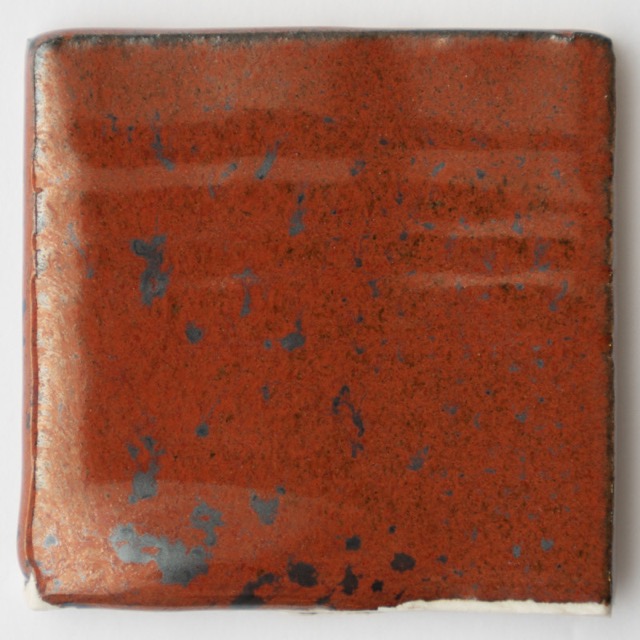
Iron is a chameleon. In oxidation: amber at 4%, tan at 6%, brown above. In reduction it shifts to FeO — a powerful flux — and produces the entire celadon → tenmoku → kaki family. With phosphorus it opalesces (chun); with high concentration it grows kaki red crystals; with rutile it produces variegated tans; with bone ash, oranges; with tin at high fire, mottled red breaks.
Sources
Red iron oxide (Fe₂O₃), yellow iron, black iron (magnetite), Spanish red, ochres, iron-rich slips (Albany, Alberta, Redart)
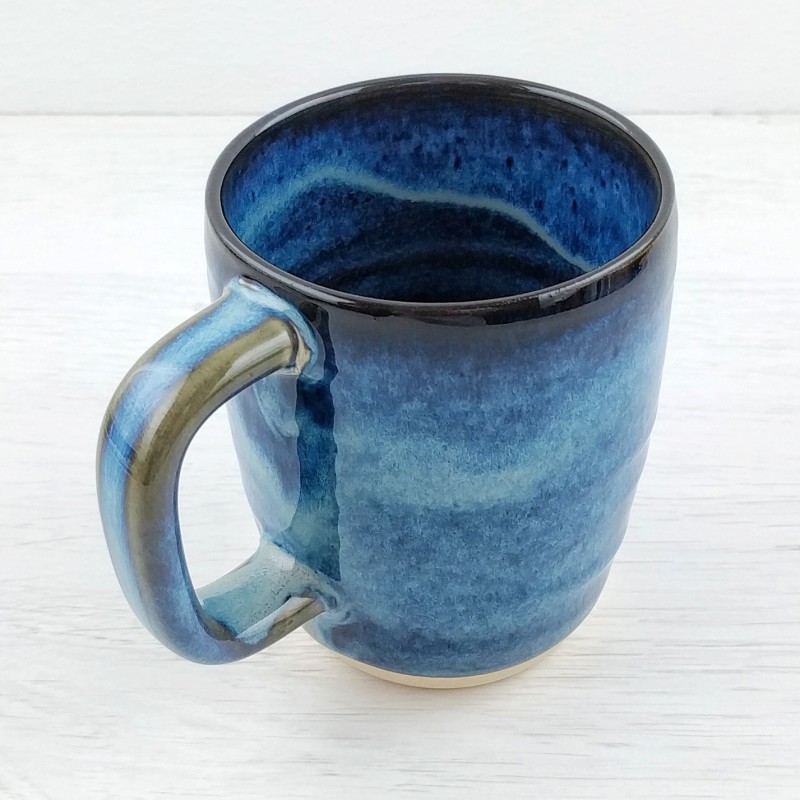
The deep blue of Yuan dynasty porcelain, Persian tankards, and Delftware. So strong that 0.1% is a real blue, 1% is saturated, beyond 2% goes black. With magnesium it can shift pink-to-violet (magnesium purple), with rutile it goes mottled and streaky, with manganese + iron it deepens to a dense black.
Sources
Cobalt oxide (CoO, very strong), cobalt carbonate (CoCO₃, finer particle, more even)
Range
0.25% pale · 0.5% middle · 1% saturated · >2% black
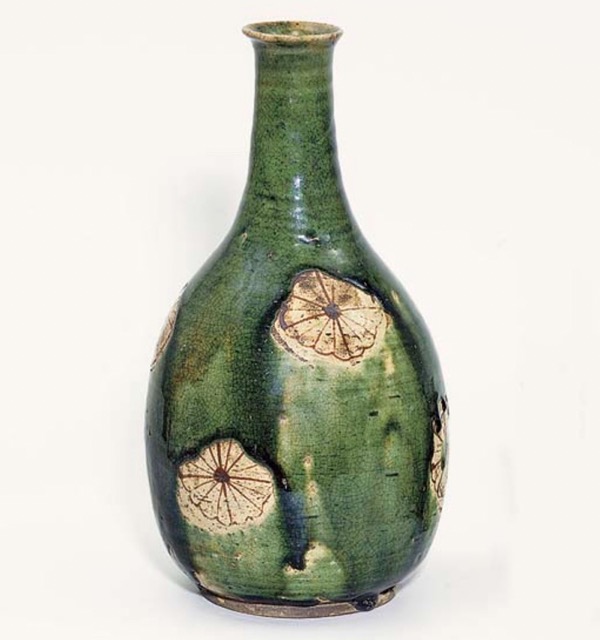
Oribe (ox.)OxbloodFlambéRaku Cu
CuO
Copper oxide
Colorant + flux
0.5 → 5 %
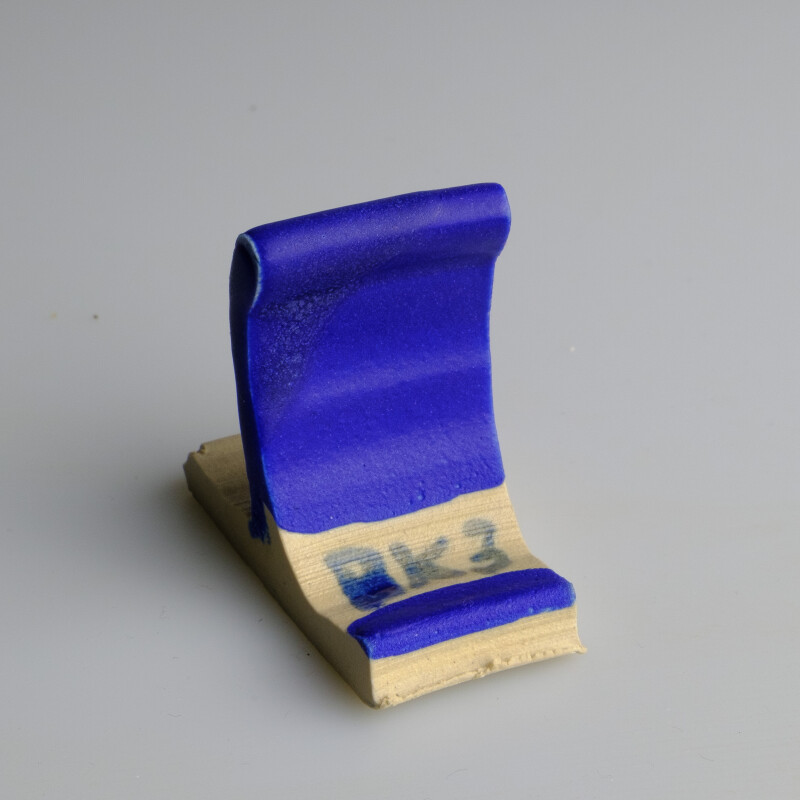
Greens, turquoises, and the great reds
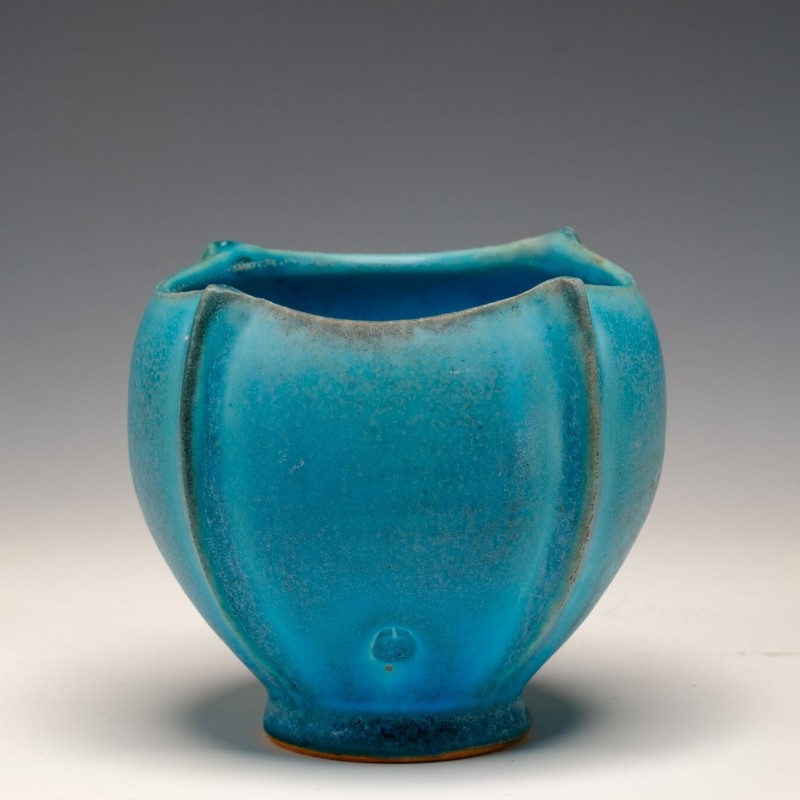
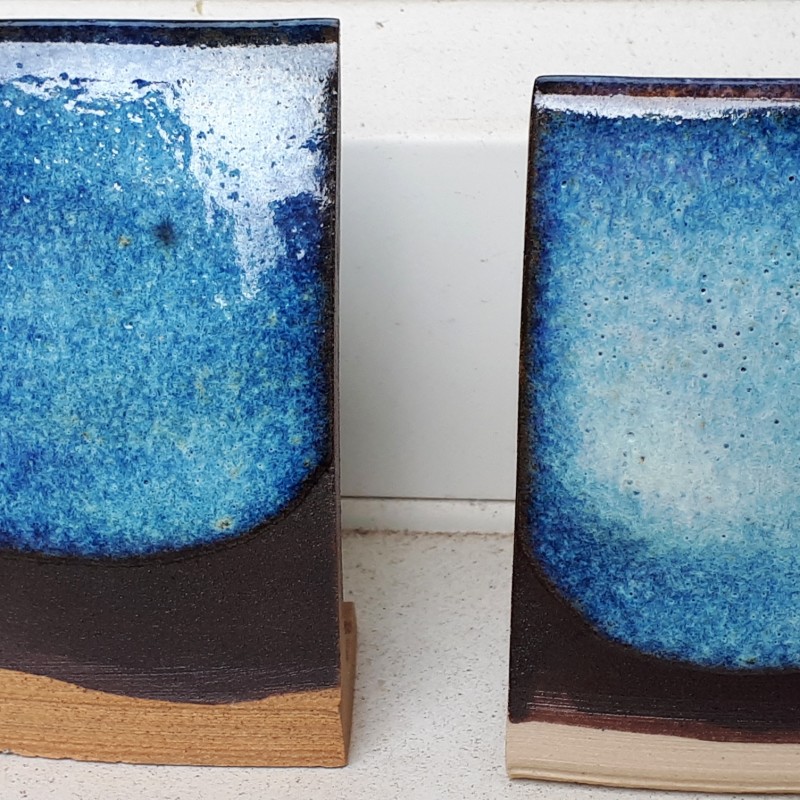
Oxidation: clear leaf green. In alkaline (sodium-rich) bases: turquoise. In barium high-fire: vivid blue and blue-green. Reduction: the classic sang de boeuf — copper-red — needing tightly controlled reduction and a glaze that traps the metallic state. Volatile above cone 8 — leaves blushes on neighbouring pots.
Sources
Copper oxide (CuO, black powder), cuprous oxide (Cu₂O, red), copper carbonate (more even disperse)
Range
0.5% pale green · 2–3% saturated green/turquoise · 1% in reduction → red
Cr green+ Sn → pink
Cr2O3
Chromium oxide
Refractory colorant
0.5 → 2 %
Olive green · pink with tin
Reliable matte forest green at all temperatures. Refractory — adds no gloss. The famous Cr–Sn pink (think 1950s suburban tile) appears when chromium is paired with tin in a calcium-rich base. Also volatile and capable of fuming pink onto adjacent tin glazes inside the kiln.
Sources
Chrome oxide (Cr₂O₃) — dull green powder
Range
0.5% subtle · 1–2% strong green · pinks at fractional %s with tin
AubergineMetallicRange
MnO2
Manganese dioxide
Colorant + mid-fire flux
2 → 8 %
Browns, purples, blacks, metallics
With alumina, browns. Without, purples. Above ~1080 °C it becomes a flux. In coarse particle form (granular manganese), produces speckles. With cobalt + iron, intense blacks. Stacked at 8%+ in low-alumina bases, metallic bronze. Like copper, prone to fuming.
Sources
Manganese dioxide (MnO₂, dark powder), manganese carbonate (lighter, more even)
Range
2% soft brown · 4% purple/aubergine · 6–8% black/metallic
Ni blueNi purpleModifier
NiO
Nickel oxide
Colour modifier
0.5 → 3 %
Soft greys, blues, yellows
Weak on its own — usually used to tone other colorants. In lithium glazes: yellow. With high MgO: greens, even acid green with help from zinc. With ZnO: steel-blue to lavender. In high-potash or lead bases: pinks. The "subtler hand" colorant.
Sources
Nickel oxide, nickel carbonate
Range
0.5% modifying tint · 2% standalone colour
Rutile blueTi greenOpacify
TiO2
Titanium dioxide
Opacifier · variegator
1 → 10 %
Opacity, mottling, crystallisation
Below 2%, dissolves invisibly. Between 2–4%, breeds micro-crystals that opacify and mottle. Above 4%, brightens colour and creates variegation; above 10%, matte and texture. Rutile is the impure-natural form (carrying iron and chromium) and is the source of the famous floating blue effect with cobalt.
Reliable, uniform, dense white. Effective at all temperatures. Slightly stiffens the melt. Sold under brand names — Zircopax, Superpax, Ultrox — typically 65% ZrO₂ in zircon form. The standard for modern white glazes since tin became expensive.
Sources
Zircopax, Superpax, Ultrox (all zircon, ZrSiO₄)
Range
5% partial opacity · 8–10% solid white · 12% maximum
Majolica+ Cr → pink
SnO2
Tin oxide
Opacifier (historic)
4 → 8 %
The Renaissance white
The classic majolica white of Italy, Spain, and Mexico. Softer, milkier, more luminous than zircon. Pairs with chrome to produce the Cr–Sn pink. Mostly displaced by zircon today on cost grounds, but still preferred for true historic majolica work.
Sources
Tin oxide (cassiterite)
Range
4% partial · 6–8% full opacity
Mason stainsBlue stainRed stains
Stains
Mason stains & equivalents
Pre-fired colorants
5 → 15 %
Vibrant, predictable colour
Manufactured by pre-firing metal oxides into stable crystalline complexes (zircon-encapsulated, spinel, rutile-locked, etc.) and grinding the result. The compromise: more reliable colour, less of the organic mottling raw oxides give; pricier; cleaner above cone 6 than raw oxides; brighter colours possible (true reds, oranges, yellows) that raw oxides cannot reach.
Use
In transparent or white base; check manufacturer's compatibility chart
Range
5% pastel · 10% saturated · 15% maximum
VII
Atmosphere — Oxidation & Reduction
Whether the kiln is rich in oxygen or starved of it changes which oxide the metal exists as inside the cooled glass — and that decides the colour.
An oxidation firing is what an electric kiln does by default — abundant oxygen, metals stay in their higher oxidised state. Reduction is what a gas, wood, or oil kiln does when fuel is starved relative to air, and unburnt carbon monoxide pulls oxygen back out of the glaze. Iron drops from Fe₂O₃ to FeO; copper from CuO down through Cu₂O to metallic Cu; manganese, cobalt, and nickel are far less affected. The colour you fire is essentially a redox state preserved in glass.
Oxidation atmosphere
Oxygen-rich
Default for electric kilns. Metals stay in their higher oxidation state. Cleaner, more predictable, more vivid bright colours; warmer iron palette; copper stays green.
Fe₂O₃Amber, tan, brown, honey. Refractory — does not flux the melt.
CuOLeaf green; turquoise in alkaline bases; vivid blue with barium.
CoOBright cobalt blue (basically unchanged in either atmosphere).
MnO₂Brown to purple to black depending on alumina & concentration.
Cr₂O₃Olive forest green; pinks with tin.
TiO₂Cream, mottled tans (with iron impurity), opacifier whites.
Reduction atmosphere
Oxygen-starved
Gas, wood, oil — fuel exceeds air. CO scavenges oxygen out of the glaze. Iron and copper transform; the entire palette deepens; ironworks become flux-active; carbon traps in shino.
FeOCeladon green-blue, tenmoku black, kaki red, oilspot, hare's fur. FeO is itself a strong flux.
Cu / Cu₂OSang de bœuf / oxblood / flambé / peach-bloom reds. Metallic copper trapped in glass.
CoOSame blue, slightly softer.
MnORoughly the same range as oxidation.
Cr₂O₃Greens; loses some intensity vs oxidation.
C trapFree carbon trapped in soda-glaze surfaces — the dark "carbon trap" of shino.
VIII
Glaze Families — A Gallery
Twelve families, forty-plus types. The categories overlap (a tenmoku is iron, an oxblood is copper, a Bristol is zinc) — but each cluster has a recognisable centre of gravity in chemistry and surface.
Iron-Based Glazes
Cone 6 — 11 · Reduction preferred
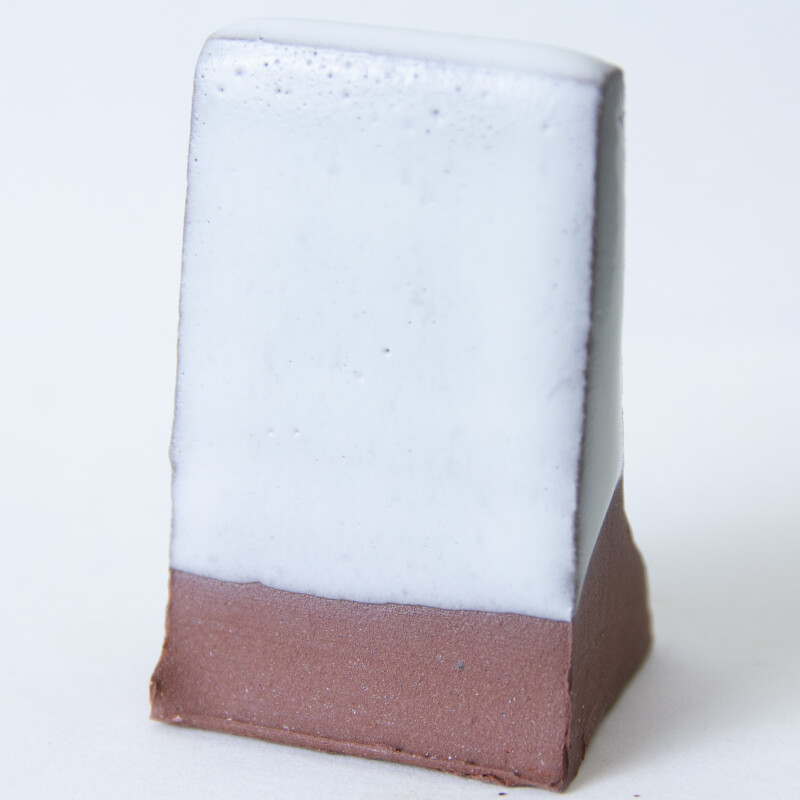
The single richest family in ceramics. From the palest celadon (≤1% Fe) up to the saturated iron-red kaki (10%+), every step is a different glaze type with a different centuries-old name. Reduction unlocks the full range; oxidation gives a warm, narrower palette.
Cone 9–11 · Reduction
Celadon
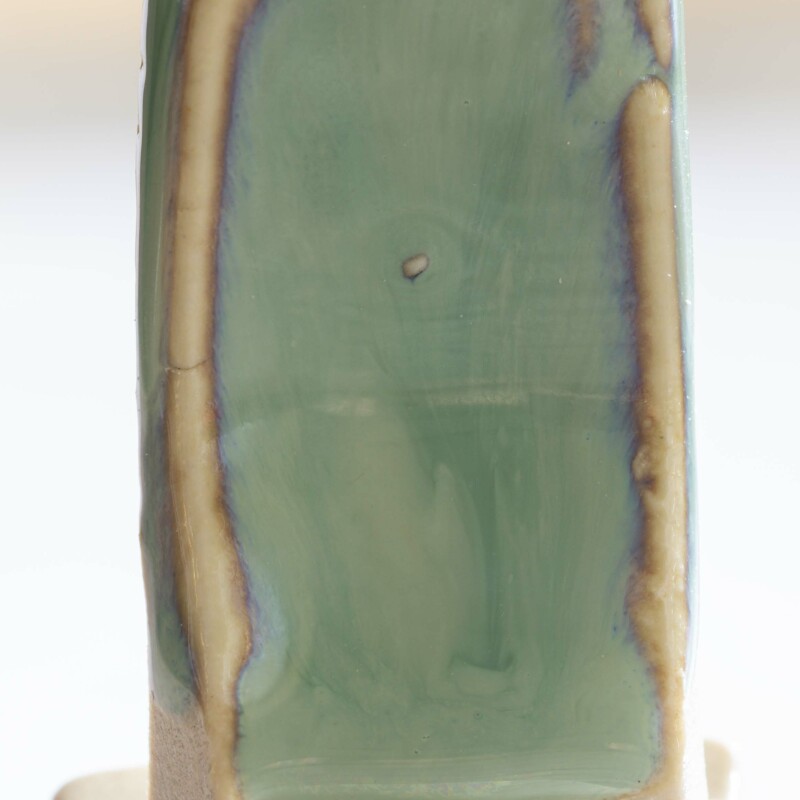
Pale translucent green-blue from 0.5–2% iron in a lime-rich glassy base, fired in reduction. The hallmark of Song dynasty Chinese ware (Longquan, Yaozhou, Ru). Shades into blue celadon at lower iron with high lime, green celadon with more iron or titania, and yellow celadon in oxidation.
Fe ≈ 1% · CaO high · low TiO₂
Cone 9–11 · Reduction
Chun / Jun
Opalescent blue-green. Phosphorus from bone or wood ash creates microscopic immiscible droplets in the glass that scatter blue light — physical, not chemical, colour. Sometimes splashed with copper-red flambé patches.
Fe + P₂O₅ + Si:Al ≈ 5–7
Cone 6–10 · Oxidation
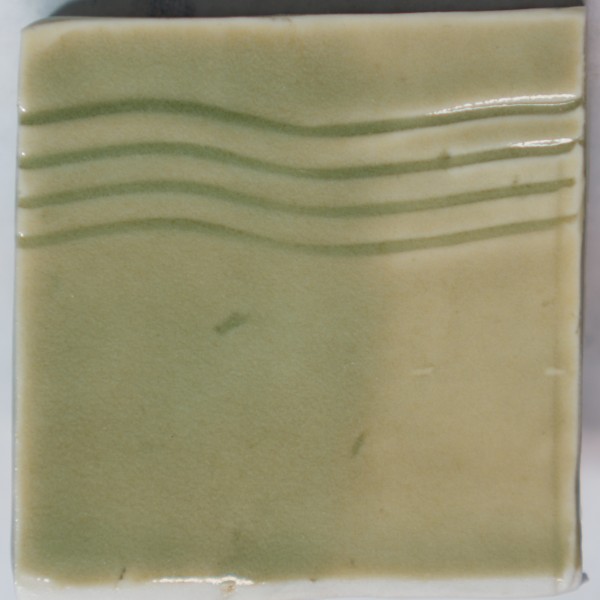
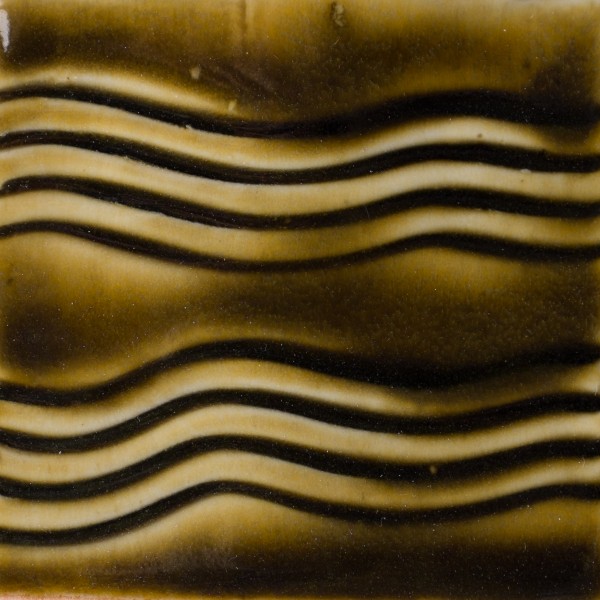
Iron Amber
Warm transparent gold-brown around 4% iron in oxidation — a more accessible cousin of celadon for electric kilns. Layers beautifully over textured surfaces; pools darker in recesses.
Fe ≈ 4% · clear gloss base
Cone 9–11 · Reduction
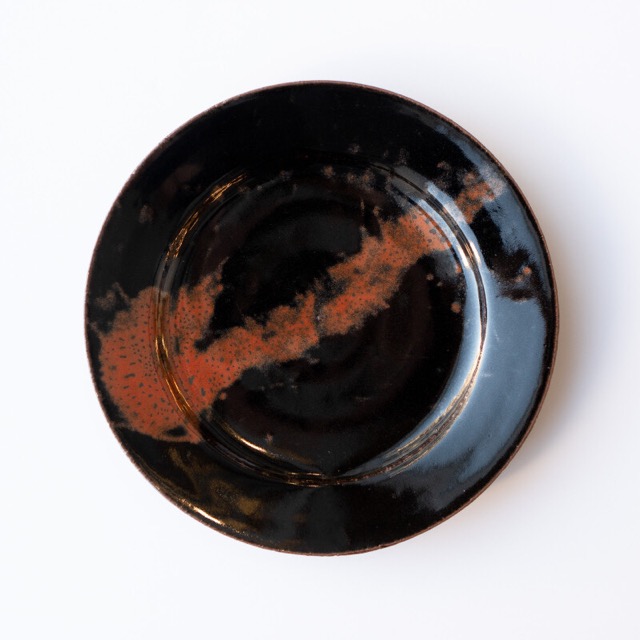
Tenmoku
Iron-saturated black, breaking to rust-red brown where it thins on edges. Around 8% iron acting as flux. Originating in Jian ware tea bowls of Song-dynasty Fujian, exported to Japan via the Tianmu mountain monasteries — hence the name.
Fe 7–9% · iron is itself fluxing
Cone 10 · Reduction
Oil Spot
Tenmoku with floating silver-bronze spots formed by iron-oxide bubbles rising and crystallising at the surface. Requires precise hold and slow cool. Jian and Cizhou kilns developed it; modern recipes still chase the right viscosity window.
Fe 8–10% + bubbling phase
Cone 10 · Reduction
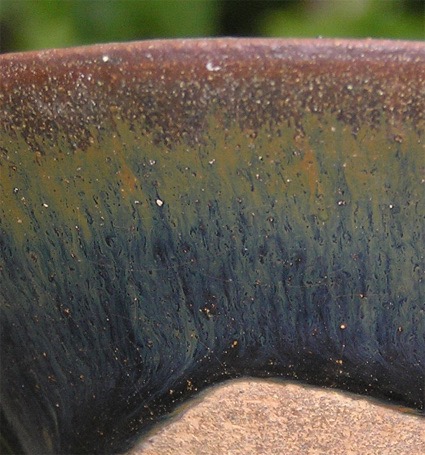
Hare's Fur
Iron-saturated glaze that runs in vertical streaks of differential iron crystallisation as the melt thins on a vessel's slope. The iconic Jian-ware tea-bowl effect — fine longitudinal striations in tan and black.
Fe 7–9% · running, fluid melt
Cone 9–10 · Reduction
Kaki / Persimmon Red
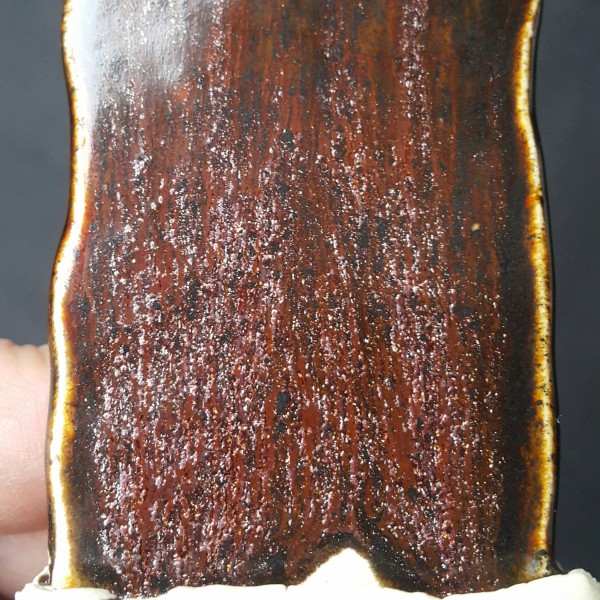
Iron pushed past saturation (10–14%) until red-brown crystals of hematite re-form on cooling, giving a matte oxidised "tomato" surface. Hamada Shōji's signature; also Northern Song persimmon-glazed bowls.
Fe ≥ 10% · crystals on cool
Cone 10 · Reduction
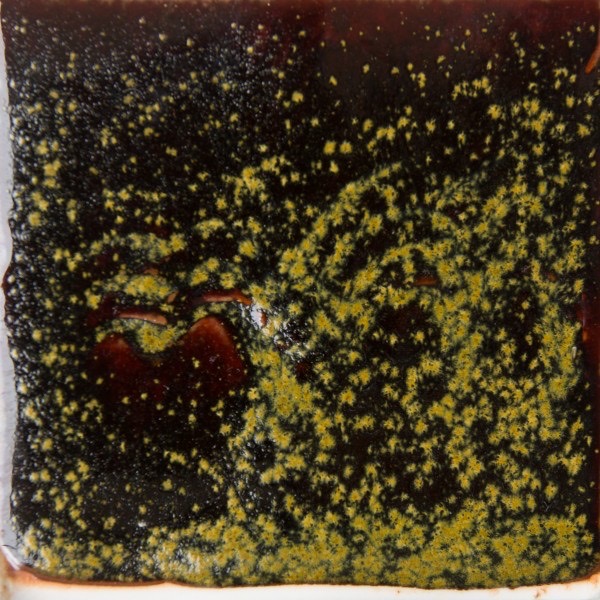
Tea Dust
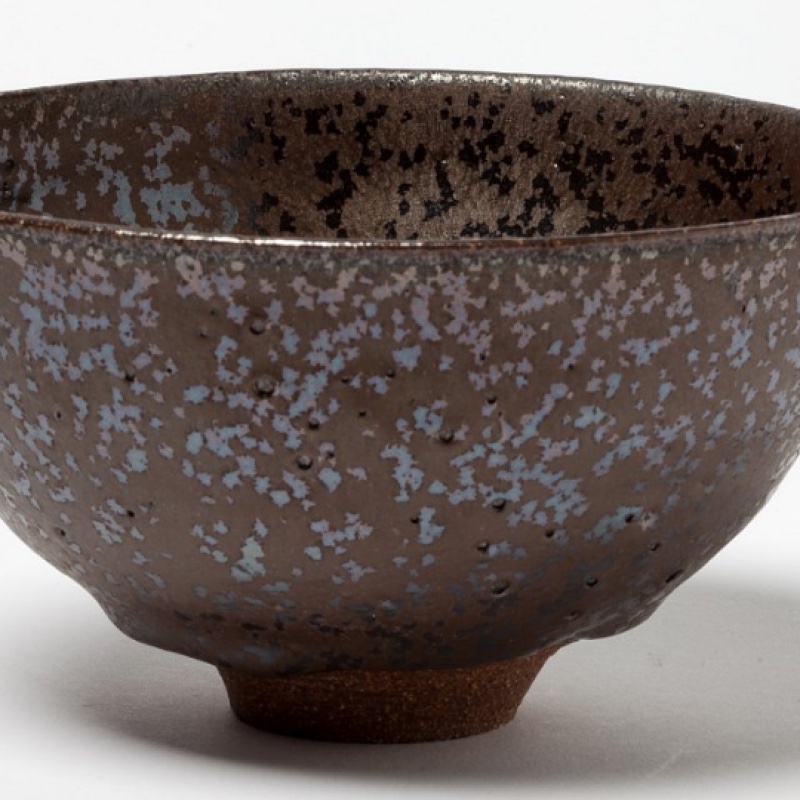
Greenish-black ground sprinkled with golden-tan crystal specks — the speckle is precipitated iron and magnesium silicates appearing during slow cool. Imperial Qing-era favourite; named for resemblance to spilt loose tea.
Fe + MgO + slow cool
Copper-Red Glazes
Cone 9–10 · Strict reduction
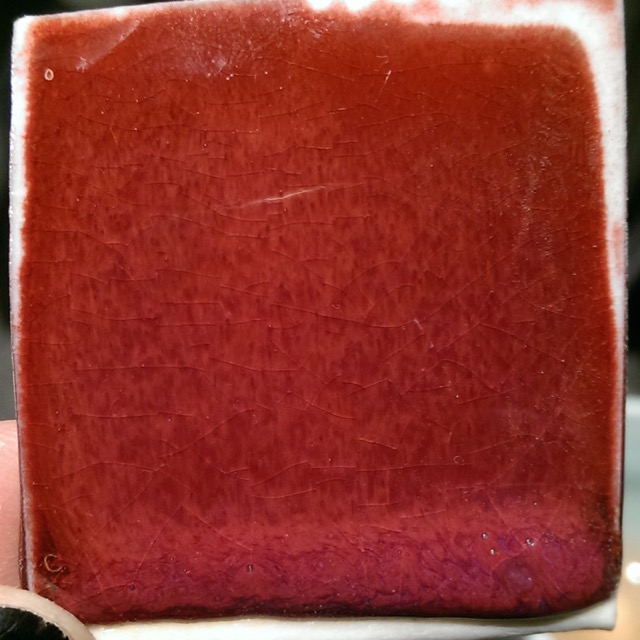
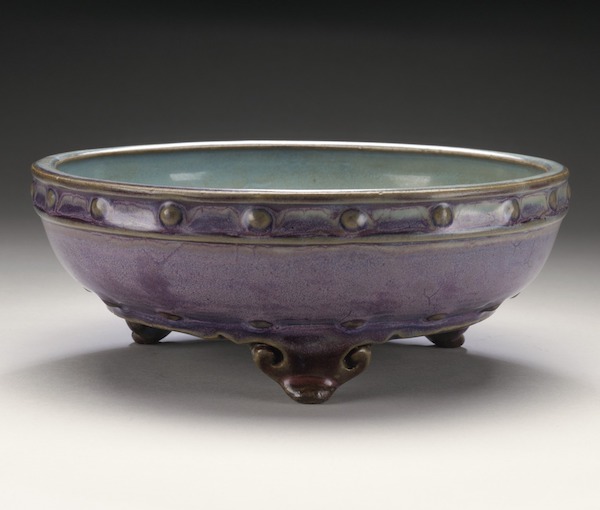
The ruby-red family — sang de bœuf in French, Jūn-style in Chinese, oxblood in English. Copper trapped as colloidal metal in the cooled glass, producing a true red. Famously fickle — the same recipe can fire green, clear, or red on three successive days.
Cone 9–10 · Reduction
Oxblood / Sang de Bœuf
Deep blood-red from 0.3–1% copper held in metallic state through carefully timed reduction. Originated in Yuan/Ming China, perfected at Jingdezhen, exported west in the 17th century where French collectors named it for the colour of bull's blood.
Cu 0.3–1% · tin 1% · reduction hold
Cone 9–10 · Reduction
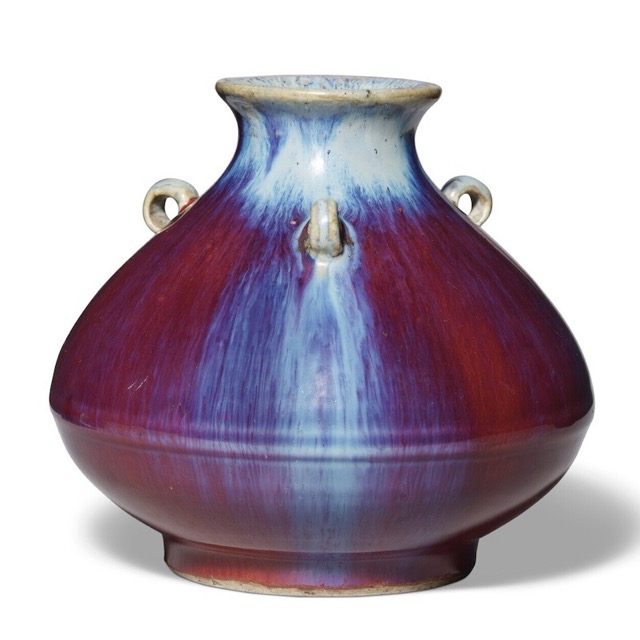
Flambé
An oxblood that streaks and runs into purples, blues, and lavenders — the result of variable thickness, partial re-oxidation, and copper-cobalt or copper-chun interactions in the run. Qing dynasty showpiece.
Cu + thickness gradient
Cone 9–10 · Reduction
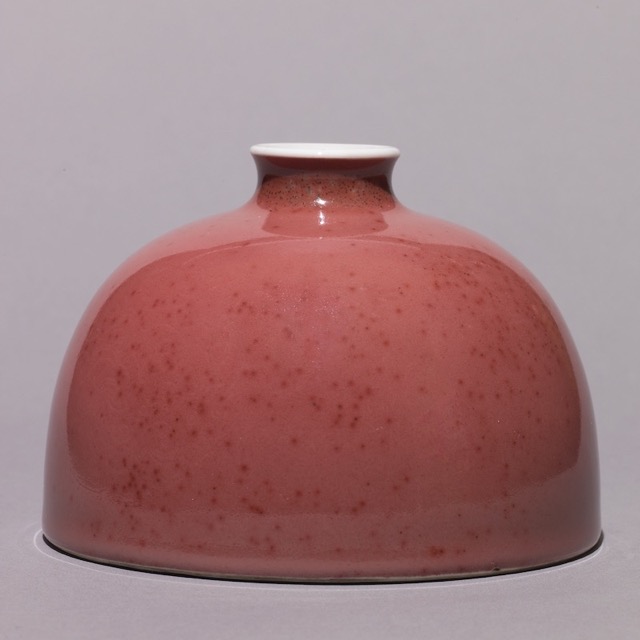
Peach Bloom
Soft pink-mottled red with subtle green bleeds. Lighter copper content (0.2–0.5%), often spray-applied for graduated mottling. Kangxi-period imperial scholar's-table objects.
Cu ~0.4% · graduated thickness
Shino
Cone 9–11 · Reduction or wood
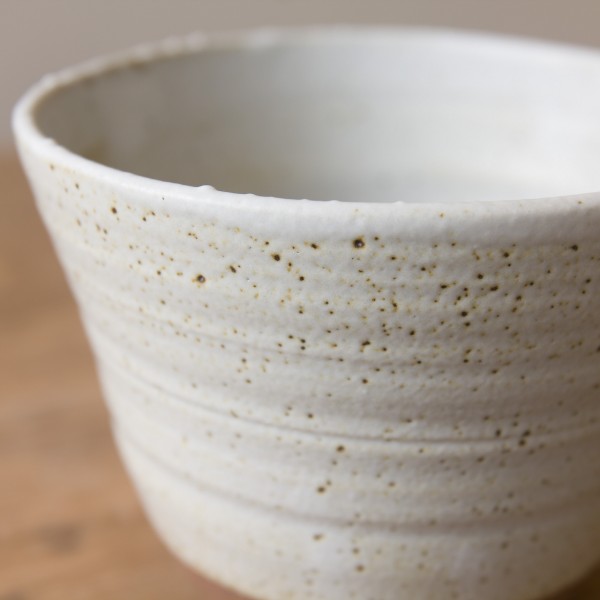
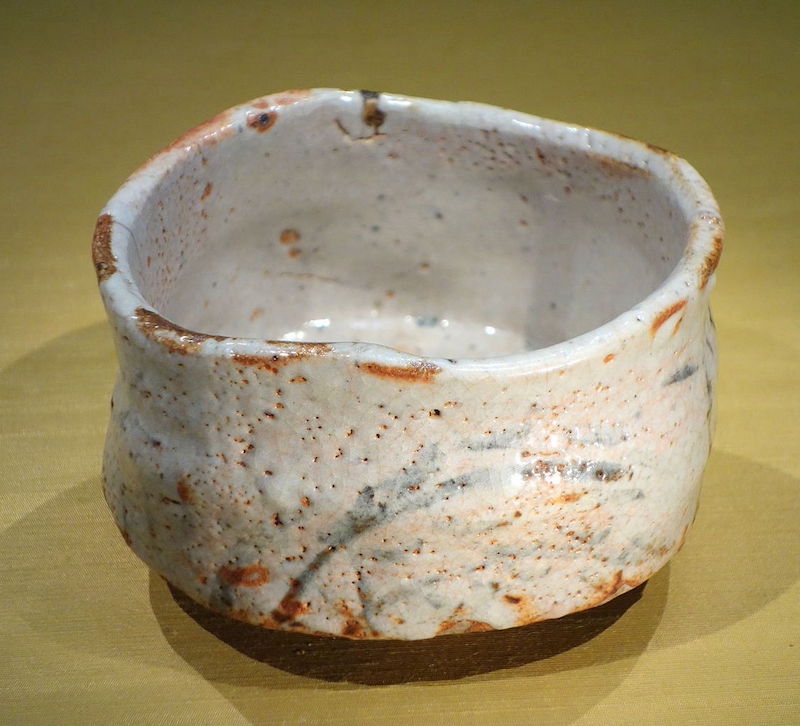
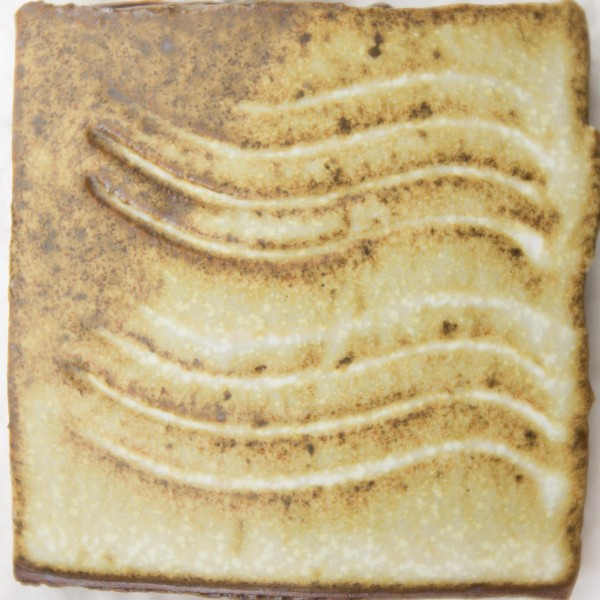
Japanese high-feldspar, high-soda glazes that look "fatty" — opaque, pinholed, breaking from white through orange to deep iron-blush at edges. The first opaque white glaze in Japan (Mino kilns, late 16th c.). Modern American shino added high-soda formulations that trap carbon during reduction.
Cone 10 · Wood / reduction
Traditional Shino
~80% feldspar, ~10% local clay, soda-rich. Surface ranges from creamy white where thick to deep orange-rust where thin and burned by iron in the body underneath. Pinholed, pitted, soft. The Mino classic.
High Na·K · low fluxes · local iron
Cone 10 · Reduction
Carbon-Trap Shino
Modern variant with soluble soda compounds (soda ash, sodium silicate) that draw to the surface as it dries. Heavy reduction during firing traps carbon under the soda crust, leaving smoky black-grey patches across cream. Pioneered in 1980s American studio practice.
Soluble Na on surface + heavy reduction
Cone 10 · Reduction
High-Alumina Shino
More clay, less feldspar — stiffer melt, more matte, less running, more reliable. Reads more like satin orange than fatty shino but easier to control on functional ware.
Higher Al₂O₃ · stiffer melt
Cone 10 · Reduction
White Shino
Shino formulated against a pale, low-iron clay to suppress the orange blush — keeping the matte fatty surface but reading creamy-white throughout.
Shino on white body
Crystalline Glazes
Cone 9–10 · Oxidation · controlled cooling
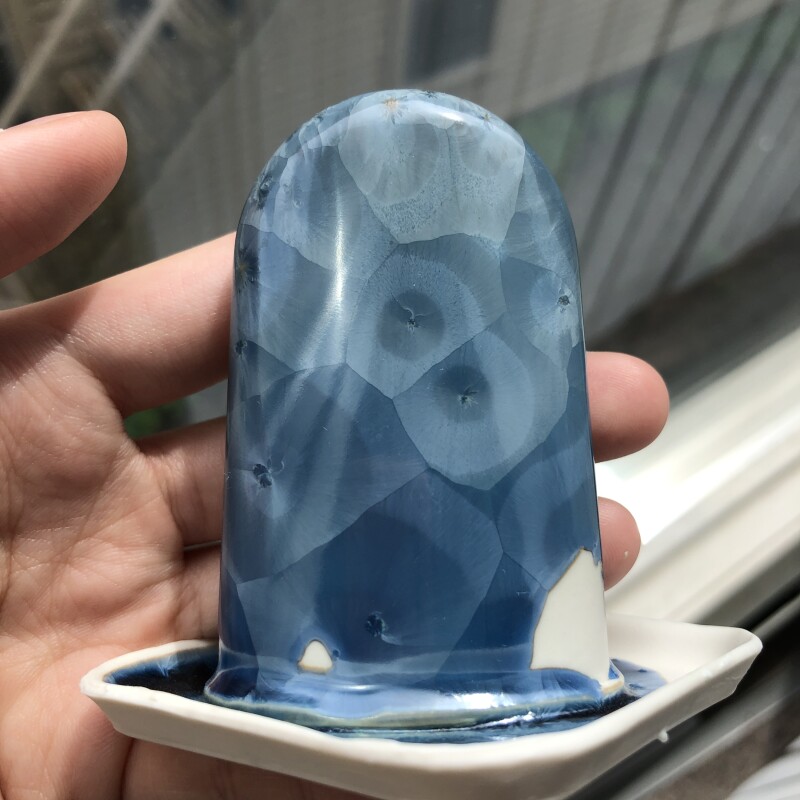
Glazes designed to grow visible crystals during the cooling cycle. The melt is held above the seeding temperature, then dropped to the growth window (around 1100 °C / 2010 °F for zinc systems) and held for hours — the longer the hold, the larger the crystal.
Cone 9–10 · Oxidation · slow cool
Macro-Crystalline
Zinc silicate (willemite, Zn₂SiO₄) crystals up to several centimetres across, grown by holding the kiln at the crystallisation window. Highly fluid, low-alumina base. Pots are fired with catch-cups under them because the glaze runs.
High ZnO · low Al₂O₃ · controlled cool
Cone 6–10
Micro-Crystalline
Networks of fine crystals throughout the glaze, often visible only as a soft sparkle or matte. Easier to control than macro-crystals; relies on titanium, manganese, or zinc to nucleate.
TiO₂ / MnO₂ + slow cool
Cone 6–10
Aventurine
Iron-saturated glass that crystallises iron platelets on cooling — a glittery dark surface flickering with gold sparkles. Direct ceramic translation of the Venetian aventurine glass effect.
Fe ≥ 10% · slow cool
Cone 9–10
Manganese Crystalline
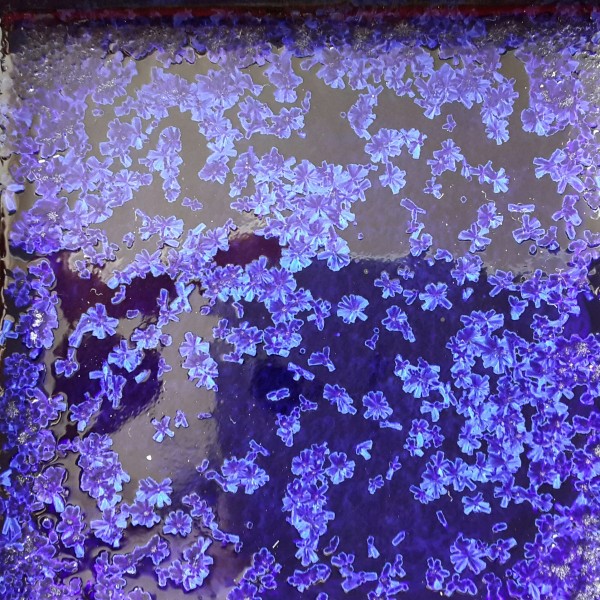
Manganese-saturated glaze yielding fern-like, iridescent crystals of manganese silicate. Can shimmer between plum, purple, gold, and bronze depending on cooling rate.
MnO₂ ≥ 5% · slow cool
Ash Glazes
Cone 9–13 · Wood, reduction, or oxidation
Wood ash is itself a complete glaze when mixed with a little clay — it carries calcium, silica, potassium, and phosphorus, sometimes magnesium and iron. Different woods give wildly different ashes (oak vs pine vs rice straw), and traditional Asian ash glazes are bound to the species used.
Cone 10 · Reduction
Wood Ash (general)
The classical formula — wood ash, feldspar, and a clay — delivering a runny, variegated, often green-grey-brown surface that pools darkly in recesses and breaks rust on edges. Highly variable; each batch of ash is its own recipe.
CaO + K₂O + SiO₂ + Fe (variable)
Cone 10 · Reduction
Nuka
Japanese rice-husk ash glaze. Husks burn to nearly pure ultra-fine silica with carbon residue. Combined with calcium-rich wood ash, gives a milky bluish-white glaze where the unmelted silica scatters light. Soft semi-gloss.
Rice-husk SiO₂ + wood ash CaO
Cone 6–10
Synthetic / Fake Ash
Modern recipes that mimic the chemistry of wood ash from clean industrial materials — whiting for calcium, talc for magnesium, bone ash for phosphorus. Repeatable; lacks the unpredictable beauty of real ash but reproducible across kilns.
Whiting + talc + bone ash + feldspar
Raku & Atmospheric Firings
Low-fire to mid-fire · post-firing reduction
Glazes designed for unusual firing processes — pots pulled from a glowing kiln with tongs and dropped in sawdust (raku); or kilns into which volatile salt or soda is introduced at temperature, vapour-glazing every exposed surface.
Cone 06–04
Raku
Low-fire glazes (high boron, often Gerstley borate-based) that mature around 1000 °C / 1830 °F. Pots are pulled red-hot, plunged into combustible reduction (sawdust, newsprint), then quenched. Crackle, metallic copper lustres, and carbon-stained crackles are the signature.
High boron · Cu / Fe colorants
Cone 9–10
Salt & Soda
No glaze applied — the kiln itself glazes. Salt (NaCl) or soda ash thrown into the firing kiln vaporises and reacts with the silica in the clay body, building a soda-feldspar glass directly on the pot. Glazes that do exist in this firing tradition are usually high-silica slips designed to feed the vapour glaze.
Vapour Na on body silica
Opaque Whites & Historic Forms
Cone 04 — 10
The traditions built on opaque white grounds — for painting, for hiding clay colour, for honouring centuries of decorative practice.
Cone 04–6 · Oxidation
Majolica / Maiolica
Opaque white tin (or modern zircon) glaze applied thick to a buff body, painted with metal-oxide pigments before firing. Italian Renaissance tradition; Spanish-Mexican talavera; Dutch delftware. The white surface holds painted detail without bleeding.
Sn 4–8% (or zircon) · low boron
Cone 5–8 · Oxidation
Bristol
The 19th-century English alternative to lead. Zinc oxide is the principal flux instead of lead or boron — produces a clean, white, hard mid-fire glaze for industrial sanitaryware. Slightly stiff, slightly susceptible to crawling.
High ZnO · no lead, no boron
All cones
Clear / Liner
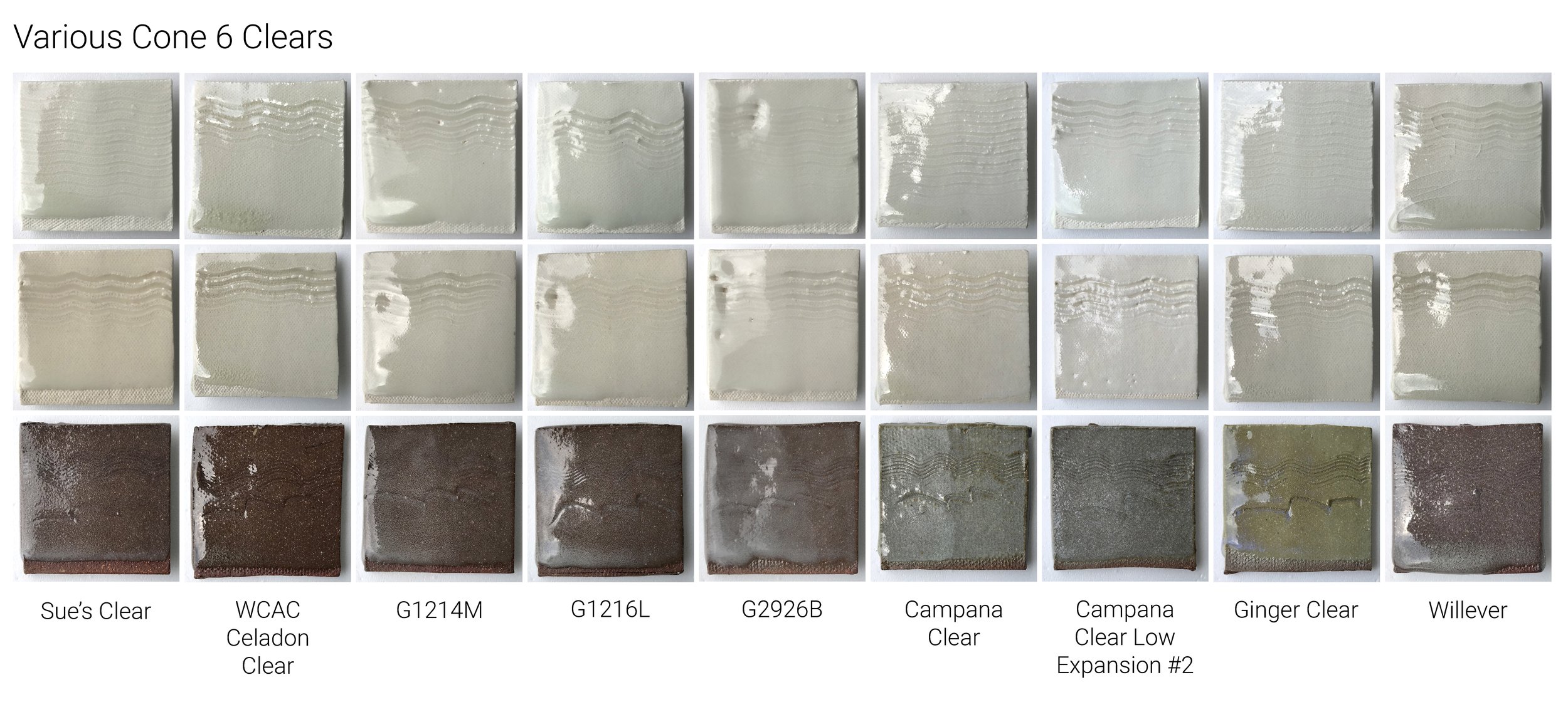
The transparent base. No colorant, no opacifier. Sits in the bright zone of the Stull chart. Used over underglaze decoration and to liner-glaze food surfaces. The benchmark every studio measures coloured glazes against.
Si:Al ≈ 6–10 · balanced fluxes
Cone 6–10 · Either atmosphere
Magnesium Matte
The defining studio matte. High-talc or high-dolomite glaze that grows magnesium silicate crystals in slow cool — surface is silky, soft, dry-feeling rather than rough. Reads almost like skin.
MgO from talc/dolomite · slow cool
Specialty Surfaces
Faults harnessed as effect
Glazes designed to behave badly — to crack, to crawl, to crater, to gloop, to crawl into puddles. Most studio "defects" are someone's signature surface elsewhere.
All cones
Crackle / Craquelure
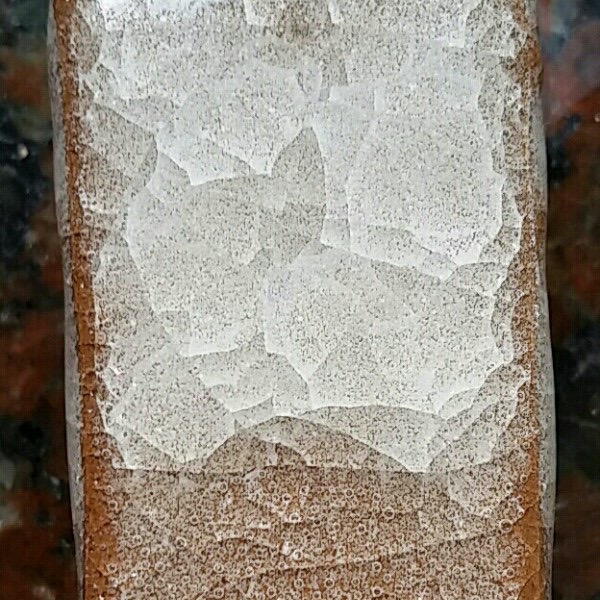
Engineered crazing — glaze deliberately formulated with high alkali expansion so it cracks across the surface on cooling. Stained with ink or tea afterwards to highlight the network. Song dynasty Ge ware is the historic prototype.
High Na/K expansion · Si:Al low
All cones
Crawling
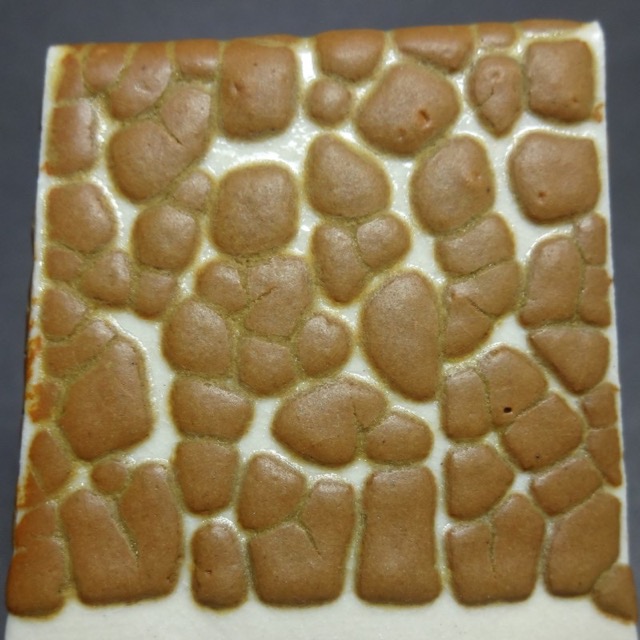
Glaze breaks open into globules during firing, exposing clay between the pulled-back pearls. Caused by surface tension exceeding adhesion — usually high MgO (light magnesium carbonate is the classic ingredient) or thick application.
High MgC · thick layer
Cone 04–6
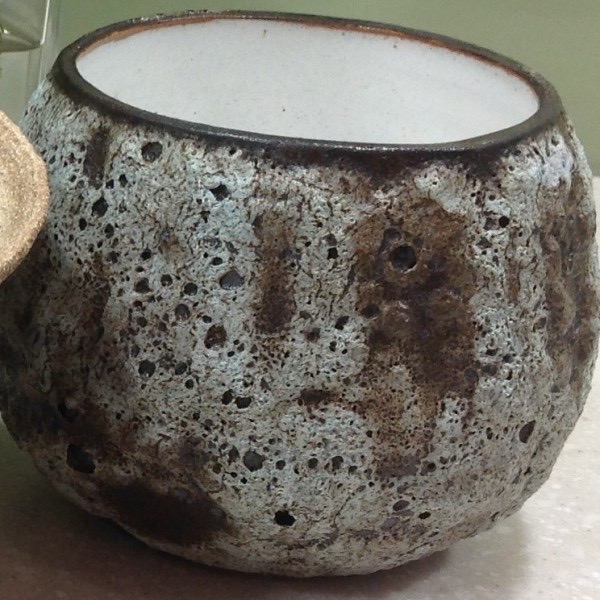
Crater
Pits and craters formed by violent gas escape (silicon carbide, dolomite breakdown, organic burnout) during the melt. Lunar, geologic surfaces. Used deliberately on sculptural work.
SiC / heavy carbonates
Cone 6–10
Metallic
Glazes pushed past saturation with manganese, iron, or cobalt until the cooling melt deposits a metallic mirror-like film on the surface. Bronze, gunmetal, oil-slick. Generally not food-safe — heavy-metal release is real.
MnO₂ > 8% · or Fe + Co + Mn stack
Cone 6–10
Magnesium Purple
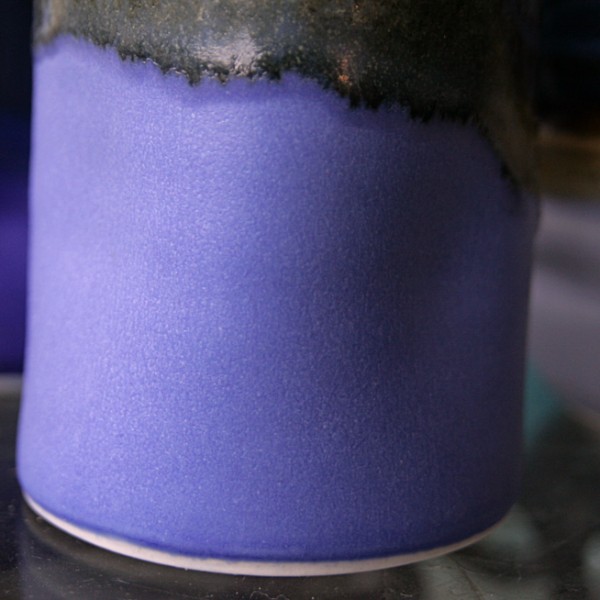
Cobalt in a magnesium-rich base shifts from blue toward pink and lavender — a chemical not pigment effect. Adding zinc kills it; adding more magnesium intensifies it.
Co 0.5% + MgO high · no Zn
Cone 6 · Oxidation
Floating Blue
Cobalt + rutile in a glossy, slightly fluid base — rutile's titanium grows micro-crystals that scatter the cobalt blue into a "floating" cloud, breaking lighter where the glaze runs thin. The most famous mid-fire studio recipe of the 1990s.
Co 0.25% + rutile 4%
IX
A Compendium of Combinations
Colour in glaze is interaction. Two oxides at the same concentration but in different hosts give different colours; flip the atmosphere and they flip again. This is the working potter's cheat sheet.
Effect / Goal
Recipe direction
Why it works
Lavender → pink
Co 0.5% + high MgO, no ZnO
Magnesium shifts cobalt's spectral response from blue toward red (the "magnesium purple" effect). Zinc kills it.
Mottled streaky blue
Co 0.25% + rutile 4–5%
Rutile's titanium grows micro-crystals that scatter the cobalt; iron impurity in rutile warms it. Floating-blue mechanism.
Intense black
Co 1% + Fe 4% + Mn 4%
Three colorants stack their absorption spectra; mid-cone density.
Vivid intense blue
Co 0.5–1% + BaO (or SrO) high
Barium/strontium hosts intensify cobalt's absorption — the bright Egyptian-blue lineage.
Turquoise
Cu 2–3% + alkaline (Na/K-rich) base, low Al
Alkali-rich, low-alumina hosts shift copper green toward Egyptian turquoise.
Copper-red (oxblood)
Cu 0.5% + Sn 1% + careful reduction at cone 9–10
Tin pre-reduces copper to colloidal metal trapped in the glass. Sustained CO atmosphere required.
Cr–Sn pink
Cr 0.1–0.5% + Sn 5–8% + CaO base
Forms calcium-tin-chromate complex — the "victorian pink" of historic majolica. Calcium is essential.
Cr → red (low fire)
Cr + PbO base, ≤ cone 08
Lead-chromate red; toxic, banned for functional ware.
Cr–Co teal
Cr 1% + Co 0.5%, cone 9+, reduction
Spectral overlap between green and blue absorbers.
Cr–Zn brown
Cr 1% + ZnO ≥ 5%
Zinc-chromate brown spinel forms; murky.
Iron-red breaks (oxidation)
Fe 4% + Sn 2% + CaO base, high fire
Tin nucleates iron crystals at glaze surface; produces mottled tan-red breaks.
Iron amber → orange
Fe 4% + bone ash 3%
Phosphorus shifts iron toward warmer red-orange; opalescence at edges.
Variegated tan
Fe 2% + rutile 4%
Titanium variegates the iron field; classic "iron rutile" surface.
Steel-blue / lavender
Ni 1–2% + ZnO high
Nickel-zinc colour complexes, weak but unique.
Yellow (oxidation)
Ni in a Li-rich base
Lithium hosts shift nickel toward yellow.
Aubergine purple
Mn 4–6% (no Co or low Co)
Manganese alone above 4% develops violet to deep aubergine.
Metallic bronze
Mn 8%+ in low-alumina base
Saturated manganese precipitates a metallic film on cool. Not food-safe.
Calcium matte
CaO above ≈ 0.4 unity
Cooling crystallises calcium silicate at glaze surface, breaking up the gloss. Classic high-fire matte.
Magnesium matte
MgO from talc/dolomite, slow cool
Magnesium silicate crystals; silky/buttery hand.
Reduce crazing
Add SiO₂ + Al₂O₃; swap Na/K → Li/MgO; add boron
Lower thermal expansion or add network. Stull chart's craze region is upper-left, low silica.
Cure shivering
Reduce SiO₂ or alumina; increase alkali
Glaze in compression; raise expansion to release stress.
Encourage pinholes
High boron + heavy carbonates + fast cooling
Gas evolution traps under viscous melt. (Use deliberately for crater texture.)
Encourage crawling
Light magnesium carbonate, thick layer
High surface tension + dusty MgC + thick film = beaded retraction.
Grow zinc crystals
ZnO ≥ 25% + low Al₂O₃ + fluid base + slow cool from cone 9
Willemite (Zn₂SiO₄) crystallises at the held growth window; size is hold-time-dependent.
X
Reading a Recipe
A small, classic mid-fire glaze decoded — recipe to oxide formula, ingredient by ingredient, into the reasons each line is there.
The recipe
A simple cone 6 stoneware glaze — Leach-style 4321
Potash feldspar40 %
Silica (flint)30 %
Whiting20 %
Kaolin (EPK)10 %
+ Red iron oxide2 %
Total = 102 % (the iron is added to a 100 % base — convention)
What the kiln sees
Potash feldspar (40%) brings ~28% silica, ~7% alumina, and ~4–5% combined K₂O / Na₂O. It is the principal flux supplier and contributes almost half the glass network too.
Silica / flint (30%) is nearly pure SiO₂. This pushes the silica:alumina ratio toward the bright zone of the Stull chart and gives the glaze hardness, durability, and scratch resistance.
Whiting (20%) is calcium carbonate, which loses CO₂ in the firing and surrenders ~11 g of CaO per 20 g whiting. This is the workhorse high-fire flux that makes the glaze actually melt at cone 6.
Kaolin (10%) adds alumina and a little silica, plus the practical benefit of keeping the glaze suspended in water and drying without cracking. Without clay in the recipe, the powder would settle hard at the bottom of the bucket overnight.
+ Red iron oxide (2%) is the colorant, added on top of the 100% base. In oxidation it gives an iron-amber transparent. In reduction it would shift toward celadon or, if pushed to 8%, toward tenmoku black.
Same recipe, fired one cone hotter, in heavy reduction, on a high-iron stoneware body, becomes a different glaze: more fluid, more variegated, breaking blacker on edges. The recipe is constant; the chemistry the kiln sees is not.
XI
The Frit Inventory — what is on US shelves
A frit is a ceramic glaze that has already been fired once into glass and re-ground to powder, so it can be used as a chemically stable, predictable, instant flux. These are the frits a North American studio can actually buy — Ferro/Vibrantz, Fusion, and the lead frits that almost no one stocks.
"Frit" comes from the Italian fritta, "fried" — a batch of raw oxides melted together at the manufacturer, quenched into shards, and ground. The result behaves more reliably than any single-source flux because the chemistry is already pre-reacted. Frits are how studios get high-boron, high-soda, fluorine, lithium, and zinc-borate compositions that simply cannot be assembled from raw materials at studio temperatures. The ten or so common North American frits below cover roughly 95% of mid-fire and low-fire studio practice.
A note on the manufacturer. "Ferro Corporation" is now a brand of Vibrantz Technologies; production of most pottery frits moved from Washington, PA to Villagran, Mexico during 2021 amid a sustained North American shortage. Most product names now carry a "-2" suffix (Frit 3134-2, 3124-2, etc.) reflecting the post-move formulation. Fusion Ceramics in Carrollton, Ohio stepped in with substitutes during the gap and is now a major studio source in its own right.
The four workhorses
borosilicates · cone 06–10 · in every studio
If you only stock four frits, these are the four. Between them they cover almost every low- and mid-fire glaze need: 3134 for boron-heavy melt, 3124 for balanced base, 3195 for cone 04 transparent, 3110 for shivering rescue and crystal work.
Ferro 3134
Calcium borosilicate · the workhorse
Ferro / Vibrantz USA
F3134 · Frit 3134‑2
Cone 06–10 · leadless
SiO₂B₂O₃CaONa₂O
SiO₂45.56%
B₂O₃22.79%
CaO19.51%
Na₂O10.14%
Al₂O₃2%
The most used pottery frit on the continent. An oxide warehouse: enormous boron, lots of CaO and Na₂O, almost no Al₂O₃ — meaning you can supply alumina from clay (which also suspends and hardens the slurry).
Useful in Cr-Sn pinks and maroons because of the high CaO. High thermal expansion makes it the lever to fight shivering. It is not a substitute for Gerstley borate — different chemistry — though it can supply the boron part of a GB substitution.
Production moved from Washington PA to Villagran Mexico in 2021 after a North American shortage. Ferro is now Vibrantz; the SKU is officially Frit 3134-2.
Substitution: Fusion F‑12 · TAM C-14 · General 367-A
Ferro 3124
Balanced calcium borosilicate
Ferro / Vibrantz USA
F3124 · Frit 3124‑2
Cone 06–6 · leadless
SiO₂B₂O₃CaOAl₂O₃
SiO₂54.94%
B₂O₃13.74%
CaO14.28%
Al₂O₃10.01%
Na₂O6.4%
K₂O0.68%
Almost a complete glaze on its own — add 10–20% kaolin to suspend and you have a working low-fire clear. Where 3134 is alumina-free, 3124 carries a real Al₂O₃ component, so the resulting glass is more durable and less prone to shivering.
Medium thermal expansion fits most clay bodies. Pair it with 3134 in an expansion-adjustable system: more 3134 → higher expansion → fix shivering; more 3124 → lower expansion → fix crazing.
Ferro 3195
High-borax/calcia for stoneware
Ferro / Vibrantz USA
F3195 · Frit 3195‑2
Cone 06–02 base · cone 6–10 boron source
SiO₂B₂O₃Al₂O₃CaO
SiO₂48.35%
B₂O₃22.62%
Al₂O₃11.98%
CaO11.36%
Na₂O5.69%
An 85:15 blend with kaolin produces a working transparent cone 04 base. Middle-of-the-road thermal expansion fits most bodies. Higher Al₂O₃ than 3134 makes it the more complete frit.
Also useful at stoneware temperatures as a clean source of B₂O₃ — none of the other oxides it carries are excessive at high fire. Above ~25% it can push boron too high for stable underglaze colour.
A soft soda borosilicate. Extremely low softening temperature (fusion point ~1400°F). Used as a shivering corrector when expansion is too low, and as the alkali backbone of crystal glazes.
Replaces feldspar in many recipes — same chemical role but enables higher kaolin content for slurry suspension. Slightly soluble; long-stored glazes can show precipitation. Formerly known as Frit 1078.
Specialty frits
low-expansion · barium · zinc-borate
Where the workhorses run out — chasing extreme low expansion, exotic colours, or a brilliance that approaches lead-glaze quality without the lead.
Ferro 3249
Magnesium borosilicate · low expansion
Ferro / Vibrantz USA
F3249
Cone 6–10 · leadless · lowest-expansion frit
SiO₂B₂O₃Al₂O₃MgO
SiO₂42.1%
B₂O₃28.9%
Al₂O₃13.3%
MgO12.2%
CaO3.5%
The frit no studio should be without when fighting crazing. It introduces MgO — the lowest-expansion flux available — in a form that actually melts at studio temperatures, unlike raw talc or dolomite.
Trading some of a glaze's Na₂O/K₂O for MgO from this frit is the most effective way to lower thermal expansion without crashing the melt. Also the basis of many silky magnesium mattes. Some users report it disrupting rutile-mottled reactive glazes for reasons not fully understood.
Substitution: Fusion F‑69
Ferro 3269
High-alkali fluorine frit
Ferro / Vibrantz USA
F3269 · Frit 3269‑2
Cone 06–01 · leadless · F-bearing
SiO₂B₂O₃Al₂O₃Na₂O
SiO₂51.23%
B₂O₃15.06%
Al₂O₃12.4%
Na₂O10.97%
K₂O7.42%
F1.5%
ZnO0.97%
CaO0.41%
Specialty alkali frit for partially-fritted gloss tile glazes. Carries fluorine (1.5%) — unusual among studio frits. Like 3110, very high expansion makes it suitable as a crackle-glaze base with ~10% kaolin added.
Unlike 3110 it has substantial B₂O₃ and Al₂O₃ and almost no CaO — so a different chemical character, even though the expansion behaviour rhymes.
Ferro 3289
High-barium frit
Ferro / Vibrantz USA
F3289
Cone 6–10 · barium-rich
SiO₂BaOB₂O₃
SiO₂49.3%
BaO27.4%
B₂O₃12.4%
Al₂O₃5.4%
Na₂O5.5%
For the bright satin colours and unique mattes that only barium can produce — particularly the vivid blues with cobalt. Uncommon in studio supply but stocked through Laguna Clay (lagunaclay.com).
Fusion FZ‑16
Zero-alumina zinc-borate
Ferro / Vibrantz USA
FZ16 · Fusion Ceramics, Carrollton OH
Cone 04–6 · brilliant gloss
SiO₂B₂O₃ZnONa₂O
SiO₂40.7%
B₂O₃30.2%
ZnO15.5%
Na₂O9.4%
CaO4.2%
The frit Tony Hansen calls the most brilliant melt he has ever tested — better than pure lead bisilicate. A serious candidate to replace lead bisilicate for high-gloss applications.
Carries no Al₂O₃, so devitrification is a real risk above cone 6. Counter it by adding kaolin or fine-mesh alumina to introduce Al₂O₃ from the recipe side. Used by volume buyers in pallet quantities; small-bag pricing makes potters wince.
Substitution: Hard to substitute — closest is a custom zinc-borate frit; raw ZnO will not deliver the same surface.
Lead frits
historic · industrial only · do not use on functional ware
Pre-fritting lead reduces — but does not eliminate — its hazards. Lead bisilicate frits are still produced for industrial and decorative-tile lines that pass leach testing under specific use conditions. North American studio suppliers do not carry them. Listed here for completeness and historical context.
Ferro 3304
High-lead clear, zincless
Ferro / Vibrantz USA
F3304
Cone 04–08 · LEAD
PbOSiO₂
PbO54.4%
SiO₂40.5%
Al₂O₃4%
Na₂O1.1%
Made from flint, soda, clay and lead. A high-PbO, zincless low-fire clear. Industrial use only; not stocked by studio suppliers in NA.
Ferro 3403
Lead alumina bisilicate
Ferro / Vibrantz USA
F3403
Cone 08–02 · LEAD
PbOSiO₂
PbO67.8%
SiO₂28.1%
Al₂O₃2.3%
K₂O1.4%
Na₂O0.3%
CaO0.1%
Essentially a lead bisilicate with stabilising additions. Very low melting temperature, used historically with Frit 3110 for bright and semi-matte wall-tile glazes.
Pb · 1:2 · Si
Generic lead bisilicate frit
Hammond Lead Products / various
Ceraflux (Hammond Lead Products)
Industrial · LEAD
PbOSiO₂
PbO65%
SiO₂35%
The reference lead frit: one mole of lead, two moles of silica. Pre-fritted to render the glass theoretically less leachable than raw lead carbonate. Lead-alumina-bisilicate variants add 1–3% Al₂O₃ for further stability.
Pottery supply companies in North America do not stock these. Manufacturers do, and claim leachability tests prove safety in their dinnerware lines. Hobby-level use is strongly discouraged. Lead borosilicate is a different material — same lead, but with B₂O₃, SiO₂, Na₂O making up the rest.
The Fusion → Ferro substitution map
2021 shortage · ongoing dual sourcing
Fusion Ceramics carry near-identical chemistry to most Ferro frits. The chemistries are not perfectly identical, but Insight-Live and Glazy substitution calculations land within tolerance for almost all studio recipes. When 3134 vanishes from your local supplier, F-12 is the go-to.
Fusion Frit
Substitutes for
Notes
F‑2
Ferro 3195
Calcium borosilicate cone-04 base equivalent.
F‑12
Ferro 3134
Adopted as the de facto 3134 substitute during the 2021 shortage; Ferro 3134 production moved to Mexico shortly after.
Unique zinc-borate, no Ferro counterpart at this writing.
A working tip. Reading a frit's chemistry is exactly like reading a glaze's chemistry — that's the point of a frit. The stacked bar above each card is a Seger formula in horizontal form: every percent point is a contribution to the eventual glass. To substitute one frit for another (Ferro 3134 ↔ Fusion F-12, for example), open the recipe in Glazy or Insight-Live, swap the materials, and let the calculator show you which oxides need a small kaolin or whiting tweak to bring the unity formula back to where it was. The frit is just the delivery vehicle.